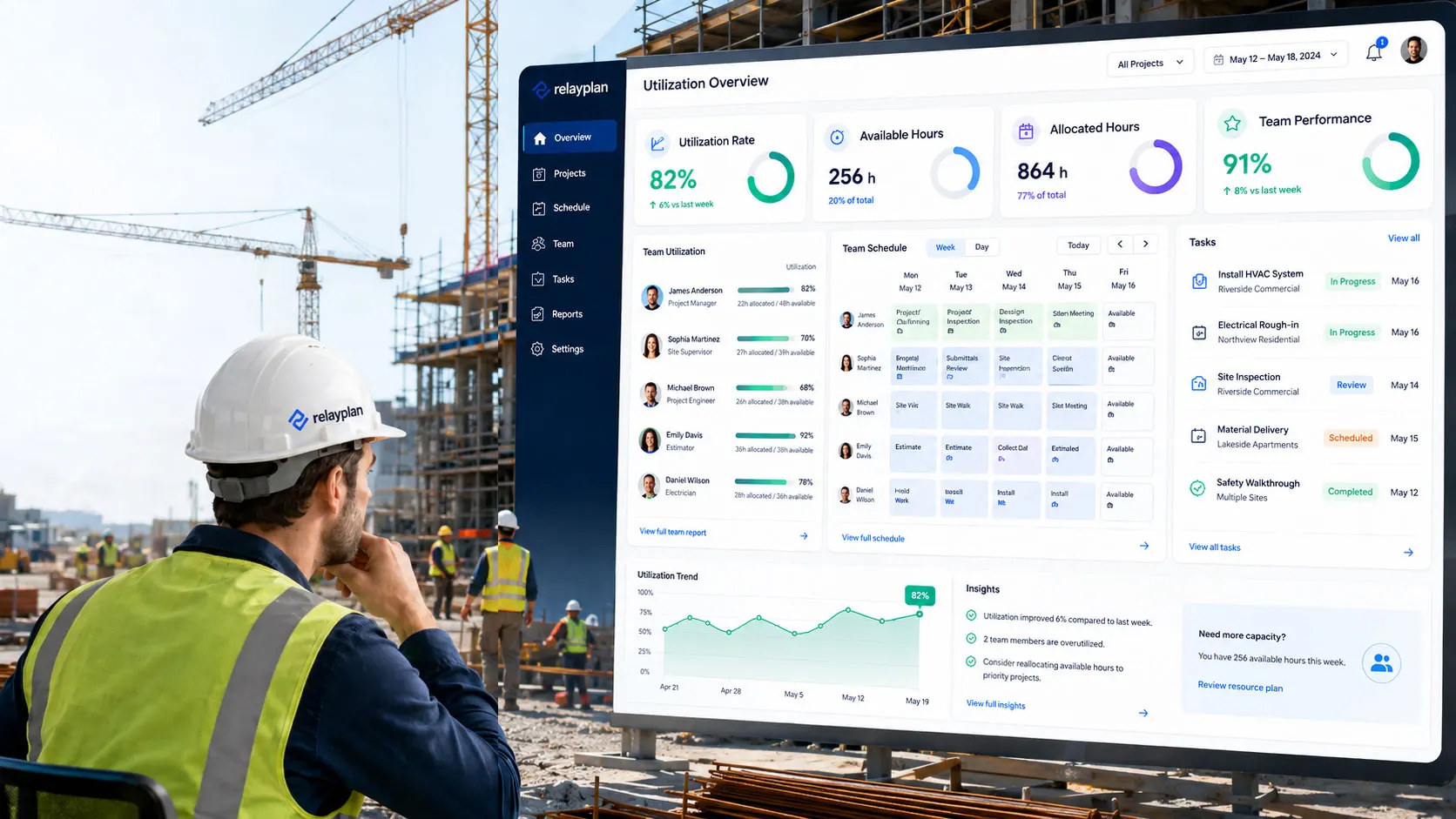
Comprehensive Project Cost Overview: How to Optimise Work, Inventory and Analytics in Construction
Every project consists of countless moving parts — teams, materials, machinery, vehicles and subcontractors. Companies often have good oversight of one segment but lose track in another.


In construction, every project consists of countless moving parts — employee teams, materials, machinery, vehicles and subcontractors. It often happens that a company has good oversight of one segment, for example employees, but loses track in another: inventory, rentals or vehicle costs.
The result is a cost picture with holes in it. And a cost picture with holes is not a cost picture at all — it is an estimate that feels like a fact.
The five cost streams of a construction project
Most companies track one or two of these well. Genuine profitability only appears when all five land in the same place.
Optimising work
Labour optimisation starts with knowing where hours actually went, not how many were worked in total. Once hours carry a project and a cost centre, you can compare similar jobs honestly and see which types of work consistently take longer than estimated.
That comparison is the foundation of better bidding. Without it, every estimate is an educated guess repeated.
Optimising inventory
Material optimisation has two halves: not buying what you already own, and knowing what a job actually consumed. The first saves money immediately; the second improves every future estimate.
- live stock levels prevent duplicate purchasing
- issues tied to projects give real material cost
- consumption history sharpens future material estimates
- slow-moving reports free up trapped working capital
Optimising machinery and vehicles
Machines are the most commonly ignored cost stream. Fuel, service, tyres and inspections are usually absorbed as general overhead, which means no one can say whether a particular machine earns its keep.
Booking machine hours against projects — the same way labour is booked — converts that overhead into an attributable cost and makes the own-versus-hire decision answerable with data.
Analytics that people actually use
Analytics fail when they arrive too late or require interpretation. The useful reports in construction are unglamorous and frequent:
Reviewed weekly, these five turn cost control into a routine rather than a post-mortem.
Bringing it together
A comprehensive cost overview is not one big report. It is the consequence of every operational action carrying a project and a cost centre with it — the hour, the material issue, the machine booking, the purchase order.
When that discipline is in place, the overview builds itself, and nobody has to spend the last three days of the month assembling it.
Final thoughts
Optimising work, inventory and analytics separately produces three partial improvements. Connecting them produces something different: the ability to know what a project is really costing while you can still change the outcome.