
From planning to a real picture of costs.
Every entry made in the field builds the data layer used for settlement, reporting and decisions. Data stops being re-typed between systems and starts being created where the work actually happens.
Why cost visibility arrives too late in most firms
The final cost of a project is not one large expense. It is thousands of small events — hours worked, material issued, equipment used, orders placed — each recorded somewhere, by someone, in a format that suits that moment rather than the business.
The consequence is familiar: hours and materials reach the office too late for decisions to change anything, and management sees the project only after the choices have already cost money. The problem is not effort. It is that the record is assembled backwards, from documents, instead of forwards, from work.
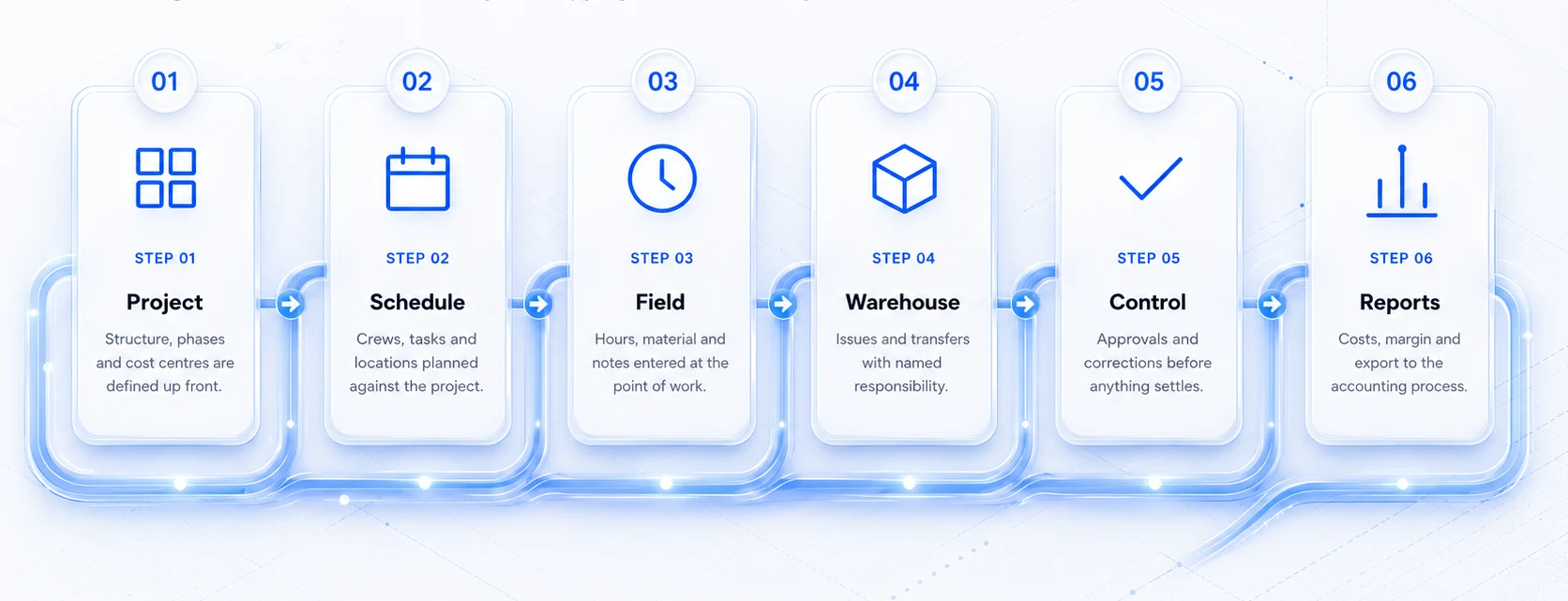
RelayPlan reverses the direction. The project structure and cost centres are defined first; then every subsequent action in the field, the warehouse and the office attaches itself to that structure automatically. By the time anyone asks what the job is costing, the answer already exists.
Six stages, one continuous record
Each stage feeds the next without anyone copying data between systems.
What this changes in practice
The value is not the diagram. It is what becomes possible once the record is continuous.
Because hours and material post as they happen, a deviation is visible in week three instead of at final settlement — when it is still a conversation rather than a write-off.
Operational data is created once and reused for settlement, reporting and accounting handover, removing the transcription work that consumes administrative time.
Every hour and every issued item carries its project and cost centre, so labour and material cost land where they belong without an accounting exercise.
Approvals, corrections and responsibility are part of the flow, so the operational history remains defensible long after the project closes.
Material movement gains a name, a time and a destination, which is usually the difference between an estimate and an actual figure for material cost.
Because the underlying record is already structured, reports are generated rather than compiled — including automatic periodic distribution.
Data flow — FAQ
Continue exploring Enterprise
Enterprise overview →Why complexity, not headcount, is what makes Enterprise relevant.
Read more →Custom modules, hosting options, integrations and reporting built around you.
Read more →The phased path from diagnostics to a measured, operational rollout.
Read more →See the chain on your own project.
A workshop with one live project is the fastest way to see where your record currently breaks.