
When the standard packages stop where your processes begin.
For construction and engineering firms with multiple roles, locations and requirements that go beyond a fixed feature list — custom modules, your choice of hosting, and an implementation designed around how your company actually works.
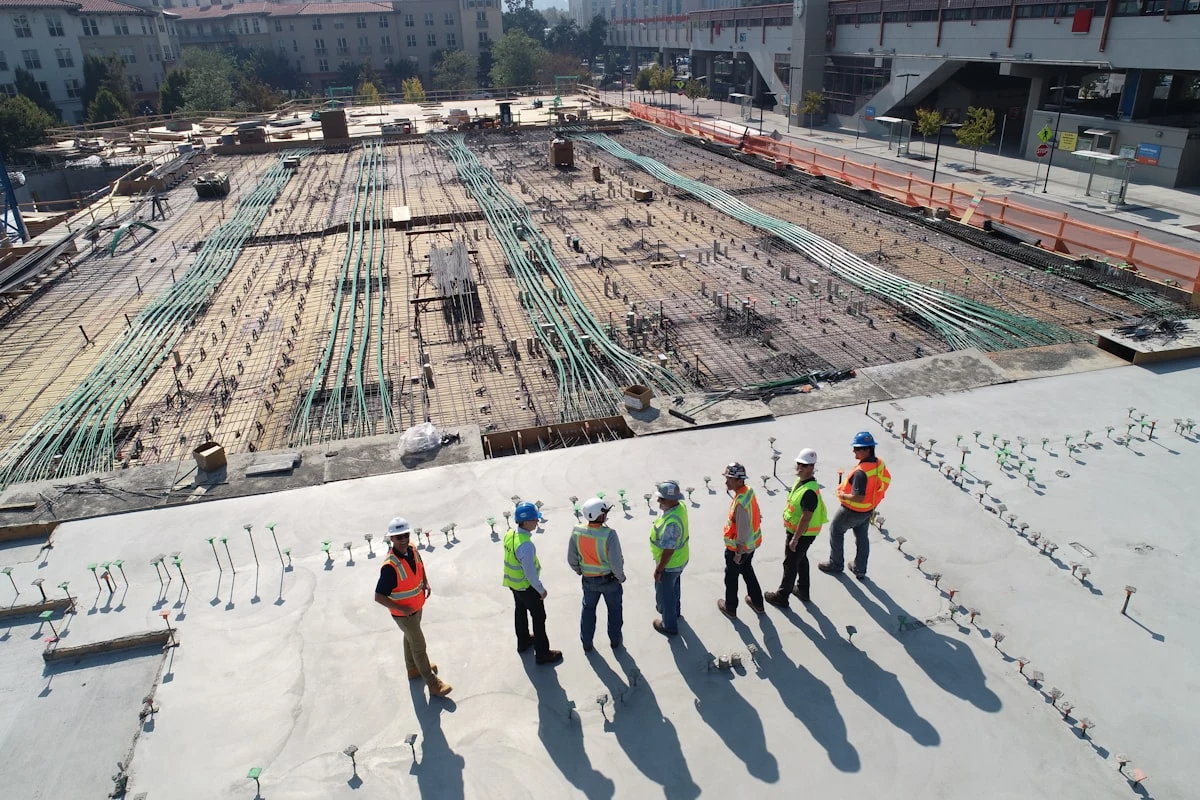
Built for organisations, not just teams
Read the full section →A construction and engineering environment needs a single data flow between the project, the field, the warehouse and management. Enterprise is where that flow gets shaped around your organisation rather than the other way round.
Managers, field crews, warehouse, administration and leadership all need to work from the same truth.
Hours, material, equipment and cost centres have to connect to the project while decisions can still be made.
Contracts, certificates, permits and safety records cannot live in folders and spreadsheets.
More roles, more locations and more involved processes require a system that adapts to the organisation.
What Enterprise adds
Read the full section →Everything in the standard packages, plus the flexibility that larger and more complex operations require.
Configurable on top, dependable underneath
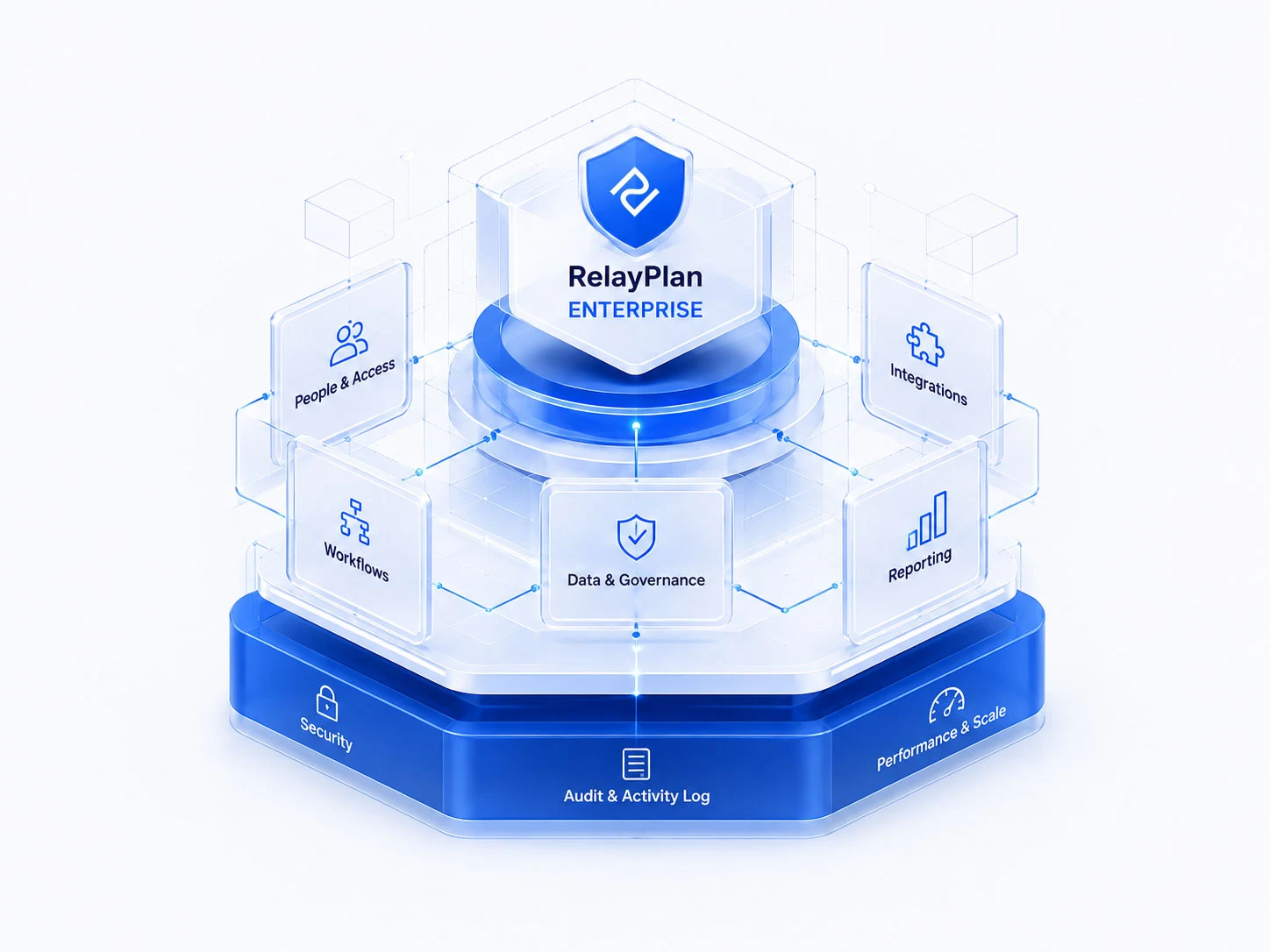
The capability layer is shaped around your organisation — workflows, permissions, integrations and reporting. Underneath it sits a foundation that is not negotiable: security, a full audit trail, and performance that holds as you scale.
Your configuration — the modules, rules and structures specific to your company.
Capability — people & access, workflows, data & governance, integrations and reporting.
Foundation — security, audit & activity log, and performance at scale.
When your process does not fit a standard feature, we build for it — additional modules, reports and automations, or changes to existing workflows, forms, permissions and approvals.
Run RelayPlan in a cloud environment we manage end to end, or self-hosted inside your own infrastructure when policy or data residency requires it.
Operational data is created in RelayPlan and passed on to accounting and other systems, reducing double entry across the business.
Permissions follow the user’s function, scoped by company, business unit or individual project, with an activity log across operational changes.
Operational and financial reports, automatic periodic reporting, and indicators defined for your organisation rather than a generic template.
A phased introduction with data migration, workshops for each team, measurement of the effect and adjustments as processes settle.
Your infrastructure, or ours
Some organisations have policies about where operational data lives. Enterprise supports either model, with the same application and the same mobile access for the field.
Access through a browser with no local installation. We handle the infrastructure, updates and backups, so your team gets one version of the system across every location.
Run RelayPlan inside your own infrastructure when data residency, internal policy or an existing IT estate requires it. We support the deployment and the upgrade path.
Example Enterprise sections
A modular design means you introduce capability in stages and adapt it to the processes, roles and responsibilities in your organisation.
From planning to a real picture of costs
Read the full section →Every entry made in the field builds the data layer used for settlement, reporting and decisions. Data is no longer re-typed — it is created where the work actually happens.
Structure and cost centres.
Crew, tasks and location.
Hours, material and notes.
Issues, responsibility, stock.
Approvals and corrections.
Costs, margin and export.
Designed to show value early, without disrupting operations
Read the full section →We recommend starting with one live project and clear indicators — timeliness of hour entry, stock variance, administrative time and cost visibility — then expanding once the habit holds.
Throughout, we measure the effect rather than assuming it, and adapt the configuration to the way your teams actually work.
Talk to us about your rollout →Mapping your processes, roles and data.
A selected project or part of a process.
Items, employees, projects and warehouses.
Project managers, administration, warehouse and field.
Expansion across projects and departments.
Reports, adjustments and integrations.
Enterprise demo account, on request
Rather than a fixed trial, Enterprise evaluations start with a test environment configured around your own processes — so what you are assessing resembles how your company would actually run.
Enterprise — FAQ
Let's scope it together.
A 30–45 minute technical workshop: we review your processes, choose a pilot scope and define measurable goals for the rollout. Demo account on request.