
Built for organisations, not just teams.
A construction and engineering business does not fail on features. It fails on the seams between the project, the field, the warehouse and management — and those seams get wider with every additional role, location and process.
Why a bigger operation needs a different system
A small crew can run on a good tool and shared habits. Once you have several project managers, multiple sites, a warehouse with real responsibility and a management layer asking for numbers, the constraint stops being the tool and becomes the flow of information between people who each hold one part of the truth.
That is the point where standard packages start to strain. Not because the features are missing, but because the organisation needs the system to reflect its own structure: who may see costs, which unit a project belongs to, which approvals must exist before work is booked, and which processes are specific enough that no generic product will ever cover them.
RelayPlan Enterprise exists for exactly that situation. The core stays simple enough for the field, while the structure around it — roles, units, permissions, approvals and custom processes — is shaped to your organisation rather than the other way round.
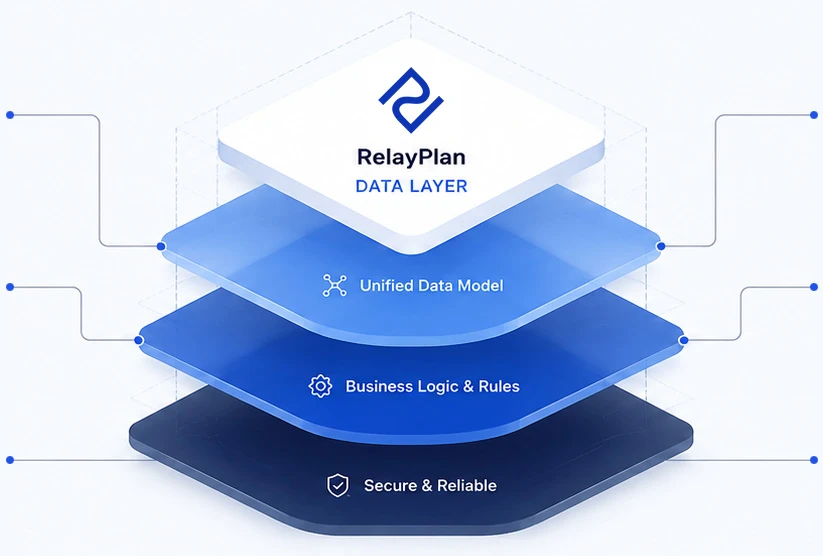
One data layer, every function
The same operational truth, presented to each role through their own lens and their own permissions.
What changes when the organisation is the unit
Enterprise is less about extra buttons and more about the system understanding how your company is actually arranged.
Companies, business units, locations and projects form a real hierarchy rather than a flat list, so data can be scoped and rolled up along the lines you already manage by.
Access follows what a person does. A site lead sees their crews and tasks; the office sees costs and documents; management sees margin — nobody sees more than their role requires.
Field, warehouse, administration and leadership work from the same records, which removes the reconciliation meetings that exist purely to agree whose spreadsheet is right.
Contracts, certificates, permits and safety records live against the project or the person, with review statuses, reminders and an audit trail — not in folders and inboxes.
Approvals, correction rules and traceability mean the operational record can withstand an audit, an inspection or a dispute months after the fact.
Where your process is genuinely specific, the system is changed to fit it — rather than your team being trained to work around a product decision made elsewhere.
Organisational fit — FAQ
Continue exploring Enterprise
Enterprise overview →Custom modules, hosting options, integrations and reporting built around you.
Read more →How field entries become the data layer for settlement and decisions.
Read more →The phased path from diagnostics to a measured, operational rollout.
Read more →Let us map it to your structure.
A short workshop is usually enough to see whether Enterprise fits how your organisation is arranged.