
From a workshop to operational success.
Implementation is designed to show value early without overloading the operation — starting with one live project and clear indicators, then expanding once the habit holds.
Why most ERP rollouts disappoint
Large implementations usually fail in the same way: everything is configured before anything is used. Months pass, expectations rise, and the first real contact between the system and the field happens at the worst possible moment — when the whole company is expected to switch at once.
The alternative is unglamorous and far more reliable. Pick one live project. Get hours and materials flowing correctly. Measure whether entry actually happens on time, whether stock variance falls, whether administrative time drops. Only then extend to the next department.
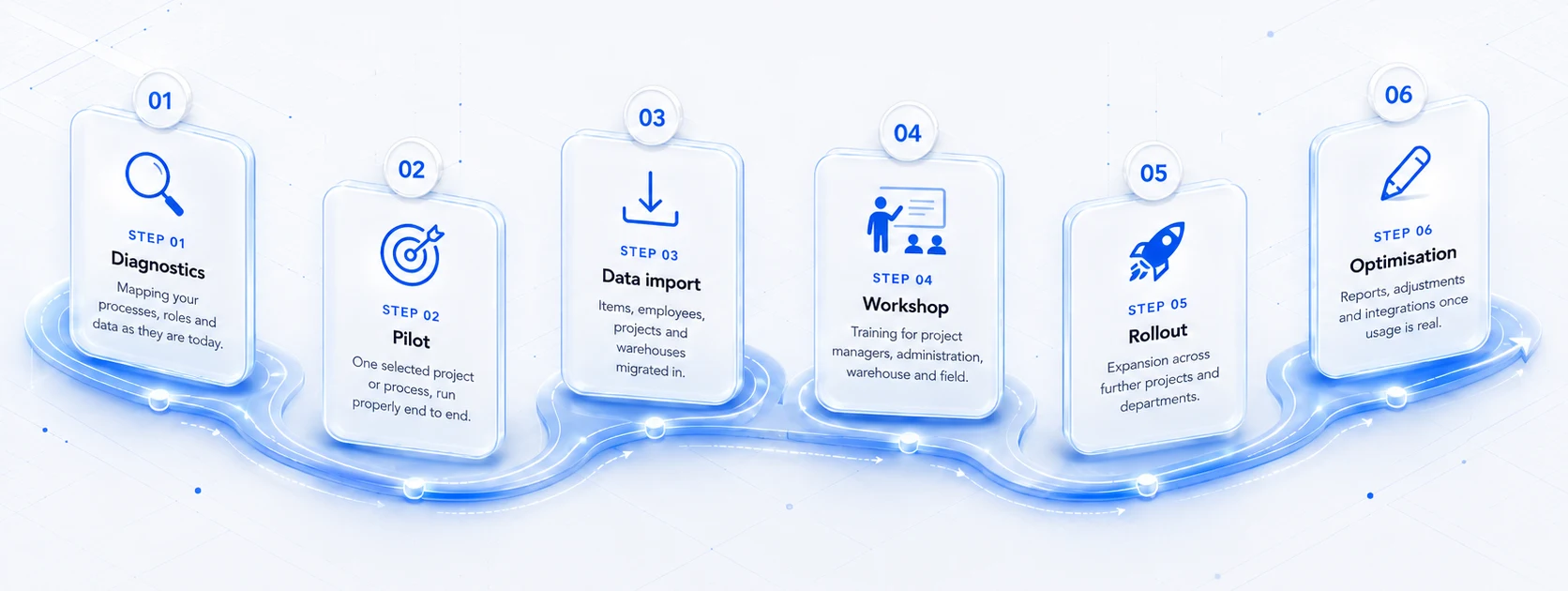
That is how we run Enterprise rollouts. Six phases, each with a defined outcome, and a recommendation to begin with a single project and explicit indicators rather than a company-wide launch date.
Six phases from diagnostics to optimisation
Each phase has a defined outcome, so progress is visible rather than assumed.
How each phase is run
The sequence matters less than the discipline of finishing each phase before starting the next.
We map the current flow of hours, project costs, warehouse responsibility and documentation — including the informal steps that never appear in a process diagram.
A single live project, chosen because it is representative rather than easy, run end to end so the whole chain is exercised under real conditions.
Items, employees, projects and warehouse structures are imported, so the pilot runs on your real data rather than samples.
Separate sessions for project managers, administration, warehouse and field, because each group needs a different half-hour rather than the same two hours.
Expansion project by project and department by department, at a pace the operation can absorb without disrupting live work.
We review the agreed indicators against reality — timeliness of hour entry, stock variance, administrative time and cost visibility — then adjust reports, processes and integrations.
Implementation — FAQ
Continue exploring Enterprise
Enterprise overview →Why complexity, not headcount, is what makes Enterprise relevant.
Read more →Custom modules, hosting options, integrations and reporting built around you.
Read more →How field entries become the data layer for settlement and decisions.
Read more →Start with a 30–45 minute workshop.
We review your processes, choose a pilot scope and define measurable goals for the rollout. No obligation.